Sunday, June 12, 2011

Tuesday, June 7th

Today we are hiking, and I am jotting down quick notes along the way. We started at 6:30 am. The guides are telling us we have about eight hours to go before reaching our next campsite. The sun is out. It is brisk but far from freezing.
__
We just reached a pit-stop and already some of the kids are tired. Our group has quickly dispersed – with the faster, more fit students charging ahead in front, and others struggling to keep up from behind. The early whining kind-of makes me laugh. Pushing kids to their absolute limits is a key component of Globetrotter travel. If only they knew… this challenge is just beginning. J
__
We are nearing 15,000 feet in elevation and the effects of the altitude are definitely starting to take their toll. Even I am finding myself short of breath, and I know I am more prepared than most. The kids are doing great… struggling, but doing great.
__
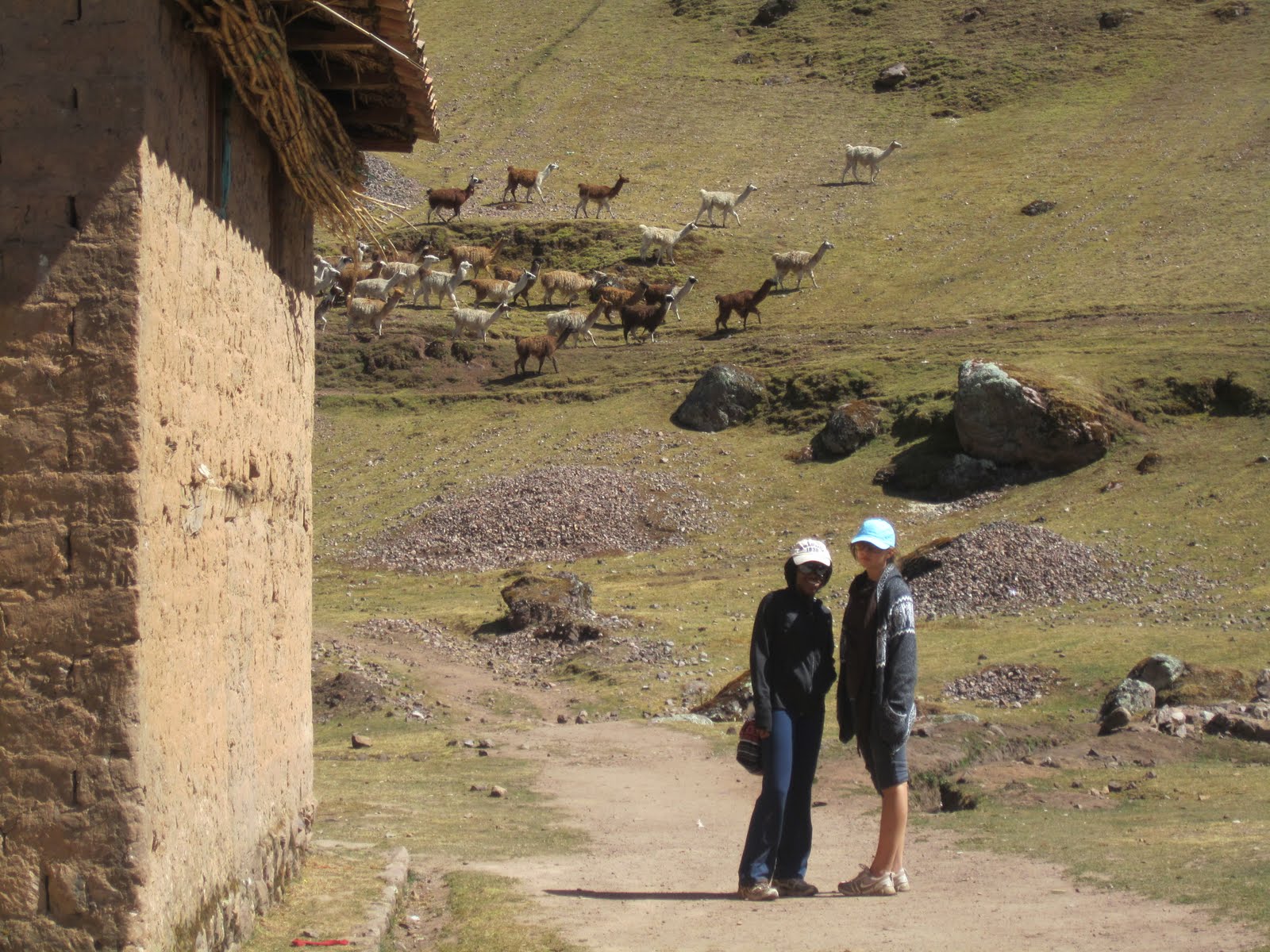
We just made it to a very small town called Waka Wasi, which means in “the cow’s house” in keshwan. Waka is the first sign of real civilization we have seen in hours. There is an older woman sitting alongside the trail with her three children. They are selling handmade wares and have 4-5 bottled drinks among their inventory – no telling how long those things have been around! At this point, I have Sarah Catherine, Ricky, Kevin and Victoria Idol in my group. I pull out 15 soles (about $5 US) and buy five braided bracelets from the woman. I pulled my struggling hikers together for what I am sure was a cheesy, but desperately needed pep talk. We tied on our bracelets, put our hands in the middle and cheered, “1 – 2 – 3 HOPE!”
__
My group finally made it to the turn – the spot where we were supposed to meet for lunch. Mario, Qlyl, Kierra and Barak arrived before us. They were lying on the ground exhausted. Upon our arrival, the porters decided it was time to set up tables and fire up their stoves. The kids head up for lunch and Freebird and I are about to head back out on the trail in search of the three remaining students who have yet to arrive.
__
Freebird took the lower trail and I took an upper, less descript path that I am guessing was “paved” by the goats and alpaca roaming the mountainside. We both encountered local village kids along the way who were eager to help us with our search. In no time, we had an old-school communication chain up and running. The kids would run ahead until they found another kid from another village. They would explain that we were looking for the Americans, and then those kids would take off running until they had reached the next village, and so on, and so on. Updates quickly started making their way back to us. We were informed that one of our three missing hikers had refused to get on the horse we had sent for them. The other two were boycotting the horses as well in support of their fellow traveler.  
Holy smokes… talk about a test of patience! 15 of our 18 team members were waiting to set-out for the next leg of our hike. We were racing against day light and here were three American teenagers throwing temper tantrums in the middle of the Andes. We had to make a decision about what to do next, so we decided to call it a day and pitch camp at the turn.
__
Our last three hikers have finally arrived. They were tired and stressed when they came up over the crest of the hill. One was actually furious, but has since apologized to the group for his heated outburst.
It’s freezing cold here, literally, and because trees do not grow at this altitude, the women who live in the shack near our campsite are helping us collect animal dung in order to build a fire. We are all gathered under a small red tent, reflecting on our day. The cooks are so dear. They continue to bring in snacks, dinner and (of course) more cocao tea.
__
It feels like midnight but it’s only 7:45 pm. We are in our tents and getting ready for bed. It’s too cold to brush our teeth or change our clothes. Several of us tried to use the bathroom behind a stone wall nearby… no luck. After taking a quick second to soak in the majesty of the Southern Cross, I have slipped into my sleeping bag, and I am clinging to the used plastic bottle the cooks filled with hot water for me after dinner. I am wishing I had ten more of these bottles. The word “cold” does not do this justice.


Monday, June 6th

We did not arrive at our campsite until close to midnight last night, so it has taken me until today (Tuesday, June 7th) to be able to get yesterday’s experiences down on paper.

Everything started out smoothly. We had breakfast at the hotel in Cuzco, boarded a bus and headed out for the Andean mountains. On the way, we stopped at a llama and alpaca farm where the kids were able to feed the animals and learn how the locals dye wool in order to make beautiful fabrics and apparel.

After our time on the farm, we made our way to Pisaq, a small town located in the Sacred Valley. We stopped in a local market to let the kids do some shopping and to try what Paul claimed were the best empanadas around. Having been warned the night before about the cold temperatures that were in store, we all stocked up on wool hats and gloves. It was fun and laid back… smiles all-around.

The curve ball came at noon, when our bus pulled up to a small turn just outside of Pisaq only to find a Peruvian guard standing in front of a shabby wood barricade. Apparently, the road was under construction, and despite our best efforts at negotiating an exception, the guard would not budge. He kept repeating, “You cannot pass until six in the night.”

Eventually, we gave up and succumbed to the fact that we were going to have to come up with a plan-B. (Sounds familiar, I know. However, this time I am convinced plan-B stands for Plan Brutal! It was the beginning of a very trying day.)

“Brutal” started out okay. We made our way to an even smaller town on the outskirts of Pisaq called Maras. Our guide informed us that Maras had once been a bustling center for commerce during the days of the Spanish trade lines. In the early 1900’s things changed. Trade slowed and people began moving on. Today Maras is close to being a ghost town.

Maras was/is built like a maze. Dirt streets take their shape from 12-15’ mud and stone walls that line (the equivalent of) city blocks. Aside from one street vendor who had set-up in the middle of the town’s main plaza, we saw no evidence of business and very little evidence of life.

Ordinarily a pit-stop in a place like Maras would not have mattered, but in our case, we had been driving for hours and several of us were desperate for a bathroom. Seeing the make-up of the place, I knew we had two options: we could either pee in the middle of the street, or start knocking on the small doors tucked into the stone walls with hopes that someone would eventually let us in.

After scouting for a couple of blocks, we finally found a woman who was willing to oblige. She agreed to let us use her “bathroom” for the equivalent of 15 cents a person, and wow… who knew something so trivial could turn into such an experience.

The woman was several inches shy of 5 feet tall. Her skin was weathered and I am sure she looked much older than she actually was. She led our group through the small, wooden door of her home. The floors were dirt and, from what we could tell, there was no electricity. When you first walked in, you were standing in what I think was her kitchen, storage area and bathroom. Chicken ran around freely, and there were stacks of projects scattered across the floor - like half-husked piles of corn. She pointed towards a small corner… the bathroom. Unlike other areas of the home, it did have a door, three walls and a thin plastic roof overhead. Other than that, it consisted of a hole in the ground. Smaller than an airplane lavatory… no running water.

There were flies everywhere and after you finished you were supposed to fill a red, plastic bowl with rainwater and wash away your “business.” I was the first person to go, and it did not take long for the disgust and desperation to leave and for utter humility and sadness to come flooding in. This is how these people live - every day! I felt guilty for tucking my used toilet paper into my pocket and for holding my nose as I thanked the woman for her hospitality. There was little to say after we left. Life is not fair… a lesson we will come face-to-face with many times on this trip.

After my small crew had used the bathroom, we met up with the others and quietly walked the streets of Maras. On several occasions, we passed homes where wooden poles with blue and red plastic bags hung from the doorway. Martha asked one of our guides what the flag-like poles meant, and her question inspired the guide to run ahead and to tuck into a Maras home. When he emerged, he had a glass full of what looked like frothy beer. He called the drink chicha and told us it was made from fermented corn. He explained that the makeshift flags indicated someone in that household sold chicha. We all tried the mystery beverage. Some were fans, others were not.

(As an aside, we have since learned that there is a little more to chicha than our guide disclosed. The drink is actually made by old men who sit around chewing on corn kernels, spitting the juice into a container, kind-of like you see people do with chewing tobacco. The bacteria from their mouths is what ferments the corn juice. So in reality, chicha is old-man corn spit. Absolutely disgusting!)

After our short stroll around town, our cooks heated up a small grill in the town center and fixed grilled cheese sandwiches and hamburgers for everyone. We also pulled out an i-Pod dock and let Sarah Catherine and Kevin start teaching the rest of the students the routine they have choreographed for our upcoming talent show in Iquitos. Man, talk about people coming out of the wood-works. Before long there were crowds of Maras residents, watching eagerly and singing along to Lady Gaga’s Born this Way. It was a beautiful contradiction of cultures. One of those moments you could never forget, nor ever recreate no matter how hard you tried.

As the time passed and our 6:00pm road-opening neared, we got back on the bus with hopes of being able to head up the mountain. This time, we passed through with no problem, and this is where the real “brutal” began to unfold. Because we were traveling so much later than expected, and the sun was quickly setting, our driver had a very difficult time finding his way. What should have been a two-three hour journey turned into six+ hours of navigating windy, narrow, unpaved roads. We all wanted to cry… and throw up… and cry some more.

When the bus finally pulled into the parking lot near our campsite, we pulled flashlights out of our bags and walked quietly down the rock path towards our tents. Some stayed up to eat dinner and soak in the hot springs. Others, like me, crawled into our sleeping bags and prayed for morning.


Saturday, June 4th & Sunday, June 5th

We have arrived in Lima. When the bus driver dropped us off on the side of the road last night and said this was our hostel, I think we all looked at him like he was crazy. From the outside, it was difficult to even point out the front door. Inside, thankfully, was a different story. There was a pool table and small café on the first floor, a ping pong table and open-aired terrace on the third. The rooms were sparse, but clean, and the people who worked there were extremely friendly and grateful to have us.
After breakfast, our group split into two. Martha and Jessica took six of the kids on to Cuzco. My parents, Freebird, OG and I stayed back with the rest and spent a few hours touring Lima before heading to the airport for a 2:00 flight.

Lima was beautiful, clean, and aside from a select number of places, almost desolate – something we had not anticipated. Today was election day in Peru, and by law, all Peruvians are required to vote. We watched with amazement as people poured into polling places, on a SUNDAY of all days, eager to stand in line and cast their vote on a paper ballot. Once they had done so, their finger was dipped into a small bowl of purple ink. So simple, but so effective… it was incredibly easy to tell who had voted and who had not.

While Lima was fun and entertaining, the real excitement of the day (at least for our group) came when we arrived at the airport. As we unloaded our bags, Victoria Idol came up to my dad and told him she thought she had left her passport in the bag of someone in group one. This meant she was in Lima and her passport (along with all other forms of photo identification) were in Cuzco. We had absolutely no idea of how we were going to go about getting her a boarding pass, through security and onto a plane at the Lima International Airport.

Parents, please do not think badly of us when I say what I am about to say. Desperate times call for desperate measures. We had to smuggle one of your children onto a plane.

Looking back, I still cannot believe it actually worked. Somehow, we managed to make it through five security checkpoints utilizing an “overwhelm and confuse” strategy, which entailed us bombarding them with a large number of English speaking teenagers at every exchange. By the time we got Victoria on the plane and into her seat, the leaders stood back and looked at one another with exhaustion AND amazement. We weren’t quite sure whether we should celebrate, or whether we should be extremely concerned about the safety of our skies.

The flight from Lima to Cuzco was smooth and uneventful; by early evening, we had reconnected with the rest of our group. We headed out to the main plaza in Cuzco for dinner where everyone tried alpaca bruschetta, shared stories from the day’s adventures and began mentally preparing for the trek that lies ahead.

Before calling it a day, we all gathered in the hotel courtyard and spent some time “self-actualizing” (as Freebird likes to call it). As always, I was both humbled and inspired by our students’ comments. They are so much more self-aware than most would ever give them credit for. If only “real life” afforded them safe, still moments to think and share. I am extremely thankful to be a part of this journey.


Monday, June 6, 2011

Loved Lima

Macen says "que pasa?"

 Joyful jumping in the city center.

Make a wish. 

Literally the only ones in the street... everyone else was off voting.

 Mi y mi madre.

Freebird recording stories for his kids.

 Lima, the city where cats sleep in trees...

 And dogs sleep under cars.

Sunday, June 5, 2011

Off to Cuzco...

Only time for one post!

Saturday, June 4, 2011

The power of ONE has made it to Peru

62 applications, 372 interviews, countless days of planning and (post selection) 5 months of bonding and preparation have all come down to one. Day-one of an adventure that will forever change the lives of eleven high school students.

If you would have asked me what the coming weeks were going to look like a year ago, I can promise you I would have described something completely different from the journey that is about to unfold. The 2011 Globetrotter Program was supposed to be centered on spirituality and self-actualization, culminating in a three-week trip to India. Seeing as we just landed in Lima, Peru, I think it’s safe to say there has been a radical change of plans.

A little history…
In April of this year we were alerted to the fact that the Indian Consulate is now requiring all minors to show proof that both of their parents possess valid US passports. A lot to ask considering 1) less than 30% of all Americans own a passport, and 2) Dustin’s GreenHouse is (for the most part) working with a group of first-generation travelers. “Mom and Pop” passports were out of the question for our group! So we rallied together and got busy. We applied every bit of due-diligence, every ounce of resourcefulness and every contact we could muster to finding a solution to the Indian Visa problem. (Just to put these efforts into perspective… US Senator Kay Hagan, US Congressman Howard Coble, 3 different attorneys, the Director of an Indian-based tourism company and an Indian pries­t were among the powerhouses in the DGH corner.)

Despite our best efforts, the clock was ticking, and by the end of the month our leadership team knew we had to make a decision. Either stick with India and risk everything falling apart at the last minute, which would have resulted in the 2011 DGH Globetrotters going nowhere, or come up with a Plan B. Welcome to day-one of Plan B (something I wholeheartedly believe was meant to stand for “Plan Blessing”).

Since our switch-a-roo at the beginning of May I have watched a collection of (teen-aged) strangers change gears, adjust expectations and grow into an incredible team of one. The maturity and flexibility with which our kids (and their families) have embraced this new plan of attack has been nothing short of remarkable. It’s been an experience unlike anything else we’ve faced over the Globetrotter Program’s 8-year history… it has brought the core of Dustin’s GreenHouse to light: we are so much more than just a “trip.”

I have included a quick outline of our “Plan B” Peruvian itinerary below. Over the next 18 days we will post as often as we can. So far, all is good on day-one. We are almost all through Customs and headed to the hotel for a good night’s rest. Adios for now.

  • The first leg of our trip will be based out of Cusco. We will allow the kids a day to acclimate to the 12,000 foot altitude before going to the Sacred Valley and then to Machu Picchu. From there we will hike Choquequirao and later visit Lake Titicaca. 
  • The second leg of our trip will be in Iquitos. We will be working with People for Peru and Poppy’s House, an orphanage for young girls. We will immerse ourselves in the small village of Santa Tomas, and will host a talent show to unite the people of the area and our team.  We will be setting up a computer lab in Poppy’s House and work with the children of the children who live in the orphanage.
  • The third leg of our trip will be a three-day jungle trip down the Amazon. We will visit small villages and learn about their customs and geography. We will bring clothing and medicine to the people in each village we visit.
  • During the fourth leg of our trip we will return to Iquitos.  We will work with families in the slums of Belen and spend a night in a home-stay environment giving our students the opportunity to experience what life is like for families living in extreme poverty.  
  • Our last stop before heading back to the United States will be at a retirement home in Lima.  The elderly people in this home have been all but forgotten by society.  We will prepare and serve lunch and spend some much needed quality time with the residents.


Tuesday, January 25, 2011

DV: Power of the Purse

A few pictures from dinner after our Village girls met with Compass Financial Partner, Ann Zuraw about budgeting and the basics of inflation and investing.


Monday, January 10, 2011

We are back and INDIA bound!

Can you believe it... it's Globetrotter time again, and this year we are India bound.

We did not waste any time getting the 2011 Globetrotter program underway. As of December 15th we had received over 75 applications, and on January 3th and 4th we invited 52 of those students in for interviews.

The Globetrotter interview process has evolved over time, and this year it went something like this:

  • The students were divided in half (between Monday and Tuesday), and then in half again (into group A and group B).
  • Each student then participated in two tracks... a group activity and a series of individual interviews that resembles speed dating.
  • After we met with all of the students, we convened and began the incredibly difficult task of narrowing 52 amazing young men and women down to 11 team members and 4-6 alternates.

I loved meeting the 2011 applicants. The interview experience always makes me proud to be alive... an American... someone who has the opportunity to work with, and learn from this incredible population of people. Some of the students who go through the Globetrotter application process have overcome obstacles like you and I have never known. Some have vision and dreams that make me feel small minded. Some are just looking for a loyal, loving and wise influence.

I could go on and on about how humbling and inspiring the Globetrotter interview process can be, but there is some exciting news I'm sure people are waiting for me to share... the recipients of our 2011 scholarships. So without further ado, here is the list:

Almoubarak Abdoulaye, Dudley High School
Ricky Anjorin, High Point Central High School
Steven Ayers, Lexington High School
Kierra Campbell, Ragsdale High School
Kevin Dang, Ragsdale High School
Victoria Idol, Ragsdale High School
Sarah Lucas, Weaver Academy
Qlyl Middelijn, Dudley High School
Victoria Perez, Middle College at GTCC High Point
Macen Revels, Middle College at GTCC High Point
Mario Scott, Smith High School

I hope you will enjoy following the journeys of this new group of young men and women.

Namaste.